



All videos (English)
Learned nothing from Iraq war 15 years ago?
05.06.2018
Subtitle "Afrikaans" was produced by machine.Subtitle "አማርኛ" was produced by machine.Subtitle "العربية " was produced by machine.Subtitle "Ārāmāyâ" was produced by machine.Subtitle "azərbaycan dili " was produced by machine.Subtitle "беларуская мова " was produced by machine.Подзаглавието "България" е създадено от машина.সাবটাইটেল "বাংলা " মেশিন দ্বারা তৈরি করা হয়েছিল।Subtitle "བོད་ཡིག" was produced by machine.Subtitle "босански" was produced by machine.Subtitle "català" was produced by machine.Subtitle "Cebuano" was produced by machine.Subtitle "ગુજરાતી" was produced by machine.Subtitle "corsu" was produced by machine.Podtitul "Čeština" byl vytvořen automaticky.Subtitle "Cymraeg" was produced by machine.Subtitle "Dansk" was produced by machine.Untertitel "Deutsch" wurde maschinell erzeugt.Subtitle "Untertitel" was produced by machine.Ο υπότιτλος "Ελληνικά" δημιουργήθηκε αυτόματα.Subtitle "English" was produced by machine.Subtitle "Esperanto" was produced by machine.El subtítulo "Español" se generó automáticamente.Subtitle "Eesti" was produced by machine.Subtitle "euskara" was produced by machine.Subtitle "فارسی" was produced by machine.Subtitle "Suomi" was produced by machine.Le sous-titrage "Français" a été généré automatiquement.Subtitle "Frysk" was produced by machine.Subtitle "Gaeilge" was produced by machine.Subtitle "Gàidhlig" was produced by machine.Subtitle "Galego" was produced by machine.Subtitle "Schwizerdütsch" was produced by machine.Subtitle "هَوُسَ" was produced by machine.Subtitle "Ōlelo Hawaiʻi" was produced by machine.Subtitle "עברית" was produced by machine.Subtitle "हिन्दी" was produced by machine.Subtitle "Mẹo" was produced by machine.Podnaslov "Hrvatski" generiran je automatski.Subtitle "Kreyòl ayisyen " was produced by machine.A magyar felirat gépi fordítással (MI) készült. Subtitle "Հայերեն" was produced by machine.Subtitle "Bahasa Indonesia " was produced by machine.Subtitle "Asụsụ Igbo " was produced by machine.Textun"Íslenska" var framkvæmt vélrænt.Sottotitoli "Italiano" sono stati generati con l'intelligenza artificiale.字幕は"日本語" 自動的に生成されました。Subtitle "Basa Jawa" was produced by machine.Subtitle "ქართული" was produced by machine.Subtitle "қазақ тілі " was produced by machine.Subtitle "ភាសាខ្មែរ" was produced by machine.Subtitle "ಕನ್ನಡ" was produced by machine.Subtitle "한국어" was produced by machine.Subtitle "कोंकणी語" was produced by machine.Subtitle "کوردی" was produced by machine.Subtitle "Кыргызча" was produced by machine.Subtitle " lingua latina" was produced by machine.Subtitle "Lëtzebuergesch" was produced by machine.Subtitle "Lingala" was produced by machine.Subtitle "ພາສາ" was produced by machine.Antraštė "Lietuvių" buvo sukurta mašina.Subtitle "Latviešu" was produced by machine.Subtitle "fiteny malagasy" was produced by machine.Subtitle "te reo Māori" was produced by machine.Subtitle "македонски јазик" was produced by machine.Subtitle "malayāḷaṁ" was produced by machine.Subtitle "Монгол хэл" was produced by machine.Subtitle "मराठी" was produced by machine.Subtitle "Bahasa Malaysia" was produced by machine.Subtitle "Malti" was produced by machine.Subtitle "မြန်မာစာ " was produced by machine.Subtitle "नेपाली" was produced by machine.Ondertitels "Nederlands" machinaal geproduceerd.Subtitle "Norsk" was produced by machine.Subtitle "chiCheŵa" was produced by machine.Subtitle "ਪੰਜਾਬੀ" was produced by machine.Podtytuł "Polska" został utworzony przez maszynę.Subtitle "پښتو" was produced by machine.Legenda "Português" foi gerada automaticamente.Subtitle "Română" was produced by machine.Subtitle "Язык жестов (Русский)" was produced by machine.Субтитры "Pусский" были созданы машиной.Subtitle "Kinyarwanda" was produced by machine.Subtitle "सिन्धी" was produced by machine.Subtitle "Deutschschweizer Gebärdensprache" was produced by machine.Subtitle "සිංහල" was produced by machine.Subtitle "Slovensky" was produced by machine.Subtitle "Slovenski" was produced by machine.Subtitle "gagana fa'a Samoa" was produced by machine.Subtitle "chiShona" was produced by machine.Subtitle "Soomaaliga" was produced by machine.Titra "Shqip" u krijua automatikisht.Превод "србски" је урађен машински.Subtitle "Sesotho" was produced by machine.Subtitle "Basa Sunda" was produced by machine.Undertext "Svenska" är maskinell skapad.Subtitle "Kiswahili" was produced by machine.Subtitle "தமிழ்" was produced by machine.Subtitle "తెలుగు" was produced by machine.Subtitle "Тоҷикй" was produced by machine.Subtitle "ภาษาไทย" was produced by machine.ንኡስ ኣርእስቲ "ትግርኛ" ብማሽን እዩ ተፈሪዩ።Subtitle "Türkmençe" was produced by machine.Subtitle "Tagalog" ay nabuo sa pamamagitan ng makina.Altyazı "Türkçe" otomatik olarak oluşturuldu.Subtitle "татар теле" was produced by machine.Subtitle "Українська " was produced by machine.ذیلی عنوان "اردو" مشین کے ذریعہ تیار کیا گیا تھا۔Subtitle "Oʻzbek" was produced by machine.Phụ đề được tạo bởi máy.Subtitle "Serbšćina" was produced by machine.Subtitle "isiXhosa" was produced by machine.Subtitle "ייִדיש" was produced by machine.Subtitle "Yorùbá" was produced by machine.字幕 "中文" 由机器生成。Subtitle "isiZulu" was produced by machine.
kla.TV accepts no liability for defective translation.kla.TV accepts no liability for defective translation.kla.TV accepts no liability for defective translation.kla.TV accepts no liability for defective translation.kla.TV accepts no liability for defective translation.kla.TV accepts no liability for defective translation.kla.TV не носи отговорност за некачествен превод.অপর্যাপ্ত অনুবাদের জন্য kla.TV কোন দায় বহন করে না।kla.TV accepts no liability for defective translation.kla.TV accepts no liability for defective translation.kla.TV accepts no liability for defective translation.kla.TV accepts no liability for defective translation.kla.TV accepts no liability for defective translation.kla.TV accepts no liability for defective translation.kla.TV nenese žádnou odpovědnost za chybné překlady.kla.TV accepts no liability for defective translation.kla.TV accepts no liability for defective translation.kla.TV übernimmt keine Haftung für mangelhafte Übersetzung.kla.TV accepts no liability for inadequate translationΗ kla.TV δεν φέρει καμία ευθύνη για ανεπαρκή μετάφραση.kla.TV accepts no liability for defective translation.kla.TV accepts no liability for defective translation.kla.TV no se hace responsable de traducciones incorrectas.kla.TV accepts no liability for defective translation.kla.TV accepts no liability for defective translation.kla.TV accepts no liability for defective translation.kla.TV accepts no liability for defective translation.kla.TV n'assume aucune responsabilité en cas de mauvaise traduction.kla.TV accepts no liability for defective translation.kla.TV accepts no liability for defective translation.kla.TV accepts no liability for defective translation.kla.TV accepts no liability for defective translation.kla.TV accepts no liability for defective translation.kla.TV accepts no liability for defective translation.kla.TV accepts no liability for defective translation.kla.TV accepts no liability for defective translation.kla.TV accepts no liability for defective translation.kla.TV accepts no liability for defective translation.kla.TV ne preuzima nikakvu odgovornost za neadekvatne prijevode.kla.TV accepts no liability for defective translation.A Kla.TV nem vállal felelősséget az esetleges fordítási hibákért.kla.TV accepts no liability for defective translation.kla.TV accepts no liability for defective translation.kla.TV accepts no liability for defective translation.kla.TV tekur enga ábyrgð á áræðanleika þýðingarinnarKla.TV non si assume alcuna responsabilità per traduzioni lacunose e/o errate.Kla.TV は、不適切な翻訳に対して一切の責任を負いません。kla.TV accepts no liability for defective translation.kla.TV accepts no liability for defective translation.kla.TV accepts no liability for defective translation.kla.TV accepts no liability for defective translation.kla.TV accepts no liability for defective translation.kla.TV accepts no liability for defective translation.kla.TV accepts no liability for defective translation.kla.TV accepts no liability for defective translation.kla.TV accepts no liability for defective translation.kla.TV accepts no liability for defective translation.kla.TV accepts no liability for defective translation.kla.TV accepts no liability for defective translation.kla.TV accepts no liability for defective translation.kla.TV neprisiima jokios atsakomybės už netinkamą vertimą.kla.TV accepts no liability for defective translation.kla.TV accepts no liability for defective translation.kla.TV accepts no liability for defective translation.kla.TV accepts no liability for defective translation.kla.TV accepts no liability for defective translation.kla.TV accepts no liability for defective translation.kla.TV accepts no liability for defective translation.kla.TV accepts no liability for defective translation.kla.TV accepts no liability for defective translation.kla.TV accepts no liability for defective translation.kla.TV accepts no liability for defective translation.kla.TV aanvaardt geen aansprakelijkheid voor foutieve vertalingen.kla.TV accepts no liability for defective translation.kla.TV accepts no liability for defective translation.kla.TV accepts no liability for defective translation.kla.TV nie ponosi odpowiedzialności za wadliwe tłumaczenie.kla.TV accepts no liability for defective translation.kla.TV não se responsabiliza por traduções defeituosas.kla.TV accepts no liability for defective translation.kla.TV accepts no liability for defective translation.kla.TV не несет ответственности за некачественный перевод.kla.TV accepts no liability for defective translation.kla.TV accepts no liability for defective translation.kla.TV accepts no liability for defective translation.kla.TV accepts no liability for defective translation.kla.TV accepts no liability for defective translation.kla.TV accepts no liability for defective translation.kla.TV accepts no liability for defective translation.kla.TV accepts no liability for defective translation.kla.TV accepts no liability for defective translation.kla.TV nuk mban asnjë përgjegjësi për përkthime joadekuate.kla.TV не преузима никакву одговорност за неадекватне преводе..kla.TV accepts no liability for defective translation.kla.TV accepts no liability for defective translation.Kla.TV tar inget ansvar för felaktiga översättningar.kla.TV accepts no liability for defective translation.kla.TV accepts no liability for defective translation.kla.TV accepts no liability for defective translation.kla.TV accepts no liability for defective translation.kla.TV accepts no liability for defective translation.kla.TV ንዝኾነ ጉድለት ትርጉም ዝኾነ ይኹን ሓላፍነት ኣይቅበልን እዩ።kla.TV accepts no liability for defective translation.kla. Walang pananagutan ang TV sa mga depektibong pagsasalin.kla.TV hatalı çeviriler için hiçbir sorumluluk kabul etmez.kla.TV accepts no liability for defective translation.kla.TV accepts no liability for defective translation.kla.TV عیب دار ترجمہ کے لیے کوئی ذمہ داری قبول نہیں کرتا ہے۔kla.TV accepts no liability for defective translation.Kla. TV không chịu trách nhiệm về bản dịch không đầy đủ.kla.TV accepts no liability for defective translation.kla.TV accepts no liability for defective translation.kla.TV accepts no liability for defective translation.kla.TV accepts no liability for defective translation.kla.TV 对翻译质量问题不承担任何责任。kla.TV accepts no liability for defective translation.

Learned nothing from Iraq war 15 years ago?
05.06.2018
www.kla.tv/12546
Exactly 15 years ago on April 14th, the US minister of defense declared that the Iraq war - also called the “second Iraq war” - was over. The Iraq war was a violation of international law - a mili-tary invasion by the USA, Britain and a “coalition of willing”, beginning on March 20th, 2003.
[continue reading]

 Odysee
Learned nothing from Iraq war 15 years ago?
Download broadcast and attachments in the wanted quality: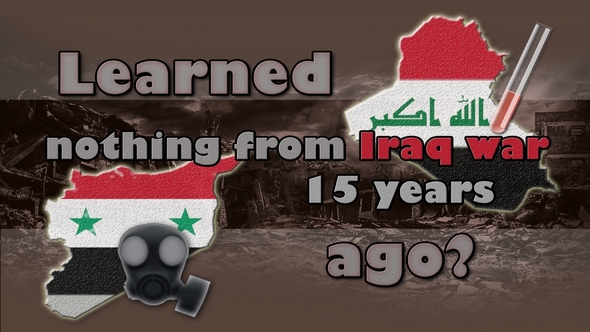
Hashtags:
Useage rights:
Standard-Kla.TV-Licence


 Element freistellen
 Element sperren
 Element löschen
 Element kopieren
 Reihenfolge ändern
 Deutsch-ID setzten
 Vimeo-ID setzten
 YouTube-ID
setzten
YouTube-ID
setzten

Trending on Kla.TV

![]()








Sendungstext
herunterladen
05.06.2018 | www.kla.tv/12546
Exactly 15 years ago on April 14th, the US minister of defense declared that the Iraq war - also called the “second Iraq war” - was over. The Iraq war was a violation of international law - a mili-tary invasion by the USA, Britain and a “coalition of willing”, beginning on March 20th, 2003. The decisive trigger of the war was a test tube shown to the UN Security Council on February 5th, 2003, by former US Minister for foreign affairs, Colin Powell. This was supposedly the proof that Saddam Hussein was in possession of weapons of mass destruction. It became clear later that this was a lie. In a television interview from September 2005 Powell expressed regret, that he had tried to con-vince the UN Security Council through statements about it being necessary which afterwards turned out to be wrong. Powell stated that this was a “blemish” in his carrier. Marching into Iraq is often described today in the USA as a “mistake”. On the 28th of March, 2018 the Iraqi author Sinan Antoon published a commentary - “How America destroyed my country”. In it he explained that this was not simply a “mistake” but, a crime. The Iraqi author - born in Bagdad - is everything but a defender of the former Head of State, Sad-dam Hussein. As a young student he landed in prison for making a joke about the president. A few months after the Gulf War in 1991 Antoon left Iraq to attend a US university and remained in the USA. In 2002 as the American people was being prepared for the Iraq war, he spoke out decidedly against the planned invasion. The USA had always supported dictators in the Arab world, including Saddam Hussein. Yet suddenly the Bush administration was presenting slogans, as if it were about democracy in the Arabic world. Antoon knew after experiencing two wars - the Iran-Iraq war from 1980-1988 and the first Iraq war from 1990 - 1991 that ”the real goals of the war are always veiled in sophisticated lies”. Sinan Antoon was one of the 500 Iraqi citizens living abroad, with varied ethnic and poitical back-grounds who signed the petition: “No to war against Iraq. No to dictatorship.” They denounced Saddam’s administration but, were against a war which would in turn turn the whole region into a bloody chaos. Their voices were unwanted in US main-stream media, which was “standing at atten-tion on the side of the war advocates. After the Iraq war ended, Sinan Antoon went back to Iraq several times; first time directly after the war and the last time in April 2017. Amongst other things he wanted to allow the Iraqi people speak for themselves through a documentary film. Antoon describes the consequences of the Iraq war like this: _ “getting rid of” Saddam was just side-effect of a different goal: namely that the State of Iraq should be destroyed and the government replaced by a badly functioning quasi-autonomous one. _ Most of the members of the new government installed by the USA were allies of the USA in the decades beforehand. They plundered the country and turned it into one of the most corrupt in the world. _ Suicide attacks became daily occurrences. The invasion of the country made it an attraction for terrorists. _ Iraq then staggered into a sensationalized “civil-war” costing hundreds of thousands of civilian’s lives and driving into exile hundreds of thousands more _ The conclusion: No one knows exactly how many Iraqis died as a result of the invasion 15 years ago. Serious estimates judge that it must be more than a million people. Try to imagine this number! The invasion of Iraq has often been called “a mistake” in the USA or even a “grave mistake”. It was a crime. Those criminals who carried it out are still walking around freely.” This is Iraqi author Sinan Antoon’s statement. It could not be any clearer. Still just the past few days, exactly 15 years later, history could be repeating itself. After the premature condemna-tion/condemning of Russia in the poisonous gas attack in Britain and especially after the “uncon-firmed chemical weapons attack, on April 7th, in the city of Duma, Syria, all the signs point again to war. Instead of the test-tube from 2003, now extremely dubious and unproved claims - that Assad had used these weapons - have to do the job. German Syria expert Günter Meyer stated that this is “complete nonsense”. It would diametrically oppose all logic, to use chemical weapons here just as the rebels were about to give up. Also Britain’s former ambassador to Syria (2003 - 2006), Peter Ford, expressed harsh criticism of this claim that Syria’s government had used poisonous gas in Duma. “Please switch on your brain!”, he responded to a BBC anchorman and asked the following question: “Why would Assad do such a thing, when the fight for Duma was nearly over? And why would he do exactly that which would cost him the victory?” In light of the fact that - opposing all logic - unfounded threats of war are looming, maybe the question should be put out as to whether certain politicians and media have any independently thinking brain left? In any case, obviously not one has learned anything from the Iraq wars!
from dd.
https://de.wikipedia.org/wiki/Colin_Powell
https://de.qantara.de/inhalt/der-irak-krieg-vor-15-jahren-wie-amerika-mein-land-zerst%C3%B6rte
https://deutsch.rt.com/der-nahe-osten/68227-konflikt-zwischen-nuklearmachten-ist-nicht-kontrollierbar/
https://deutsch.rt.com/international/68234-britischer-botschafter-ad-zu-giftgasvorwurfen/
https://www.youtube.com/watch?time_continue=347&v=3j_Z1f84Ps8